
Guide to spot a fake Cuban Cigar


The allure of Cuban cigars captivates cigar enthusiasts globally, making the experience of smoking one highly desirable. Sadly, this popularity attracts illicit activities, with dishonest individuals selling counterfeit or fake “Cuban” cigars to unsuspecting buyers. Numerous organizations worldwide, including trade unions and government bodies, have developed strategies to combat the import and production of these fraudulent “Cuban” cigars. While SS Alliance has successfully intercepted counterfeit cigars in the past, a significant surge of fake Cubans has recently been observed. These counterfeit cigars not only spoil your enjoyment but also pose severe health risks. Often made from factory floor waste tobacco contaminated with substances like rat droppings, human hair, and dust, they are not only repulsive but also a serious health hazard. These foreign materials can lead to significant health problems and may even be toxic.
Identifying a fake Cuban cigar doesn’t always require expert knowledge. With some practice and careful observation, you too can distinguish them. At SS Alliance, our commitment extends beyond using our resources to block the import and distribution of fake cigars. We also aim to raise awareness within the Pakistani cigar market to protect consumers from health issues and financial exploitation.
Here, we are presenting you with a few tips to spot a fake Cuban cigar:
1. Buy From SSAlliance authorized retailers and spot SS seal
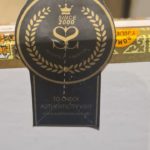
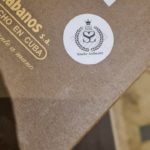
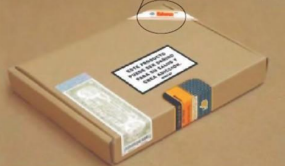
Every original box of Cuban cigars can only come through its exclusive distributor in the region. Therefore, only buy from SS Alliance’s official retailers. SS Alliance applies 2 stickers on every box that is being distributed in Pakistan. Look for the ‘Guarantee of Quality’ Seal and the white ‘Smoke Authentic’ sticker at the bottom.
2. There are no cheap Cohiba, Montecristo and Limited-edition cigars
Yes, you can get sales and bargains around the world, but there are no cheap Premium Cuban cigars. The prices are usually regulated and costs-of-sales too high to ever present a ridiculously low price. So if you come across a really cheap “Cuban”, it is probably fake!
3. Labels go on the box
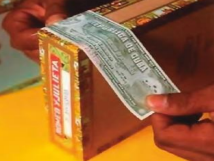
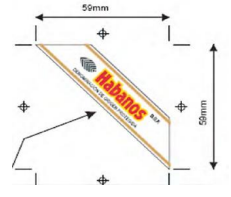
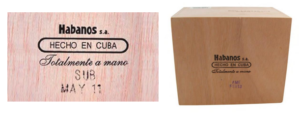
Learn about the three main labels on a Cuban cigar box: a Habnos label, a stamp at the bottom of the box and a seal with a barcode. Usually counterfeit products have these labels “inside” the box. A genuine product will always have these three “on” the box! Below is the picture of the labels as a reference:
4. Use the code
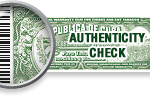
You can never be too sure; just use the barcode on the seal of the box, run it on Habanos.com and verify in seconds if you have an original product!
How To Spot a Fake Bolivar

1) Clear Detail On Embossed Coins
The two gold coins adorning each side of the Bolívar logo should exhibit crisp and intricate details. Take a close look at each one. If any of the images appear blurred or if the gold color bleeds into the surrounding background, or if you notice any inconsistencies in the patterns around the edges of the coins, the cigar band could be counterfeit.
2) Raised Coins
You should be able to feel the details on the gold coins; they aren’t just printed flat. Gently run your finger over them and you should notice raised ridges that define the images. If the coins feel completely smooth and lack any texture, the band is likely a fake.
3) Habana & Cuba printed on label
Older versions of the Bolívar cigar band simply featured the word “Habana.” However, the current band design now includes “Cuba” printed directly beneath it.
4) Raised borders
just like the coins on the Bolívar band, the beaded borders encircling the logo and the edges of the band itself should have a noticeable raised texture. Run your finger over these areas; if they feel flat instead of having distinct bumps or ridges, it could indicate a fake.
How To Spot A Fake Cohiba
1) Holographic Taino Indian Head
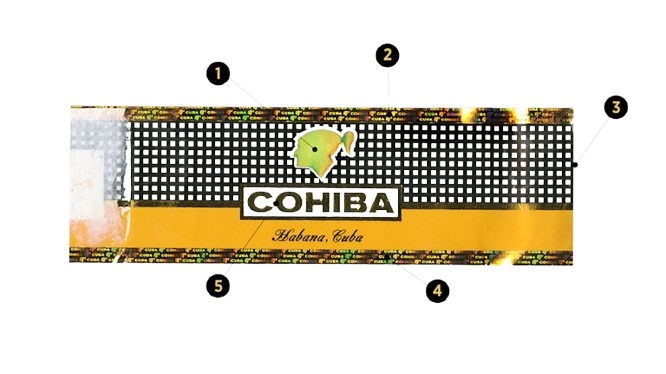
The prominent holographic image of the renowned Taino Indian head is located in the middle of the band. If you examine it more closely, you’ll notice a smaller version of the same head contained within the larger one. This “head-within-head” detail is a strong indicator of the band’s authenticity.
2) Holographic Elements
Holograms of the word “Cuba” and the Taino Indian head logo repeat on the gilded top edge of the band.
3) Nine White Squares
Starting from the shiny, holographic gold top edge and extending down to the solid gold line that covers the bottom third of the band, you’ll see nine rows of white squares arranged in a checkerboard design. It’s important to observe that all these squares are complete and not cut off at either the top or the bottom row.
4) Repeating Logos
The Cuba and Taino Indian head logos repeat along the gilded, holographic bottom and top edges.
5) Embossed Lettering
The well-known “Cohiba” name, presented in white on a square with a gold border, features raised lettering with a proper, shiny metallic gold finish. However, this gold is not holographic.
How to spot a Fake Cohiba Behike BHK

1) Holographic Taino Indian Head
The well-known Taino Indian head takes pride of place in the center of the band, rendered as a hologram. Upon closer inspection, you’ll observe a fascinating detail: a smaller version of the same head is embedded within the larger one. This “head-within-a-head” feature is a strong indicator of the band’s authenticity.
2) Holographic Elements
Along the gold-colored top edge of the band, you’ll see repeating holographic images of both the word “Cuba” and the iconic Taino Indian head.
3) Nine White Squares
From the gold-colored top edge down to the top of the word “Behike,” there are nine distinct rows of white squares arranged in a checkered pattern. It’s crucial to observe that these squares are complete and not cut off along either the top or bottom row.
4) Repeating Logos, Checkerboard Pattern
The gold foil box features a repeating checkerboard pattern created by holographic Taino Indian head logos and boxes containing the words “Behike” and “Cohiba.”
How To Spot a Fake Romeo y Julieta
1) Lines To the Band’s Edge
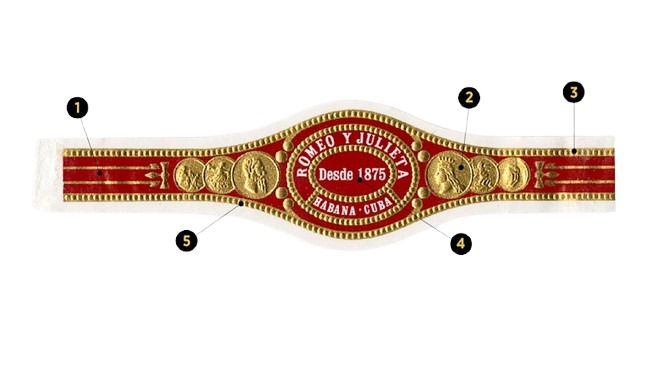
The gold lines situated within the textured gold border should extend completely to the very edge of the band. If these lines stop short and don’t reach the end of the red background, the band might be a fake.
2) Clear Detail on Embossed Coins
The three gold coins on either side of the Romeo y Julieta logo should have a raised texture and clear details. Gently run your finger across them and take a close look. If any parts of the coin feel flat or if the outlines of the faces show any imperfections, it’s a strong indication that the band is counterfeit.
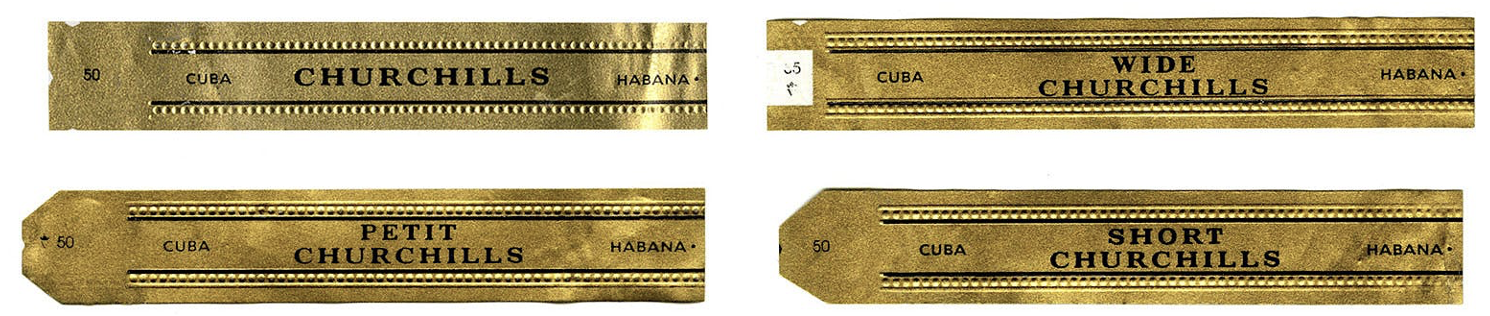
Secondary bands appear on Romeo y Julieta’s Churchill line. Clockwise from top left: Churchill, Wide Churchill. Short Churchill, Petit Churchill.
3) Embossed Borders
The gold beaded borders along the outer edges of the red background, as well as the oval shapes in the middle of the logo, should have a raised texture that you can feel.
4) Lettering
Older versions of the Romeo y Julieta cigar bands used to feature the text “Rodríguez, Argüelles y Cia.” While some counterfeit bands might still carry this stamp, authentic, current Romeo y Julieta cigars will display the brand name at the top, with “Habana · Cuba” (separated by a small white dot) underneath. In the center of the band, the text now reads “Desde 1875” (Since 1875).
5) Gold Beads on Border
Carefully examine the gold beads forming the border. The spacing between each bead should be consistent, and the raised texture (embossment) should be uniform across the entire border.
How To Spot a Fake Montecristo

1) The Fleur-de-Lis
Since 2013, the fleur-de-lis, the central design element of the band, has been embossed in gold. Run your finger across the band to check if the logo has a raised texture. If the fleur-de-lis feels flat, the band is likely a fake.
2) Gilded Lines
The wavy gold lines that run through the middle of the band should be the same shade of gold as the fleur-de-lis. However, unlike the fleur-de-lis, these lines should not have a raised texture.
3) The Brown Band
The color of the band underwent a subtle change in 2007. The brown now has a deeper, redder tone, resembling the color of a bean rather than the earlier milk chocolate shade. Additionally, the current band has a glossy finish, whereas some counterfeit bands might mimic the pre-2007 matte-green color.
4) White Circles
The white circles, the two dots, and the borders located outside the band’s gold lines should all have a raised texture (embossed) and a consistently bright-white color. Pay close attention to the sharpness and evenness of these circles and lines. If they appear uneven, faded, or have irregular shapes, it’s a possible sign of a counterfeit cigar.
How To Spot a Fake Partagás
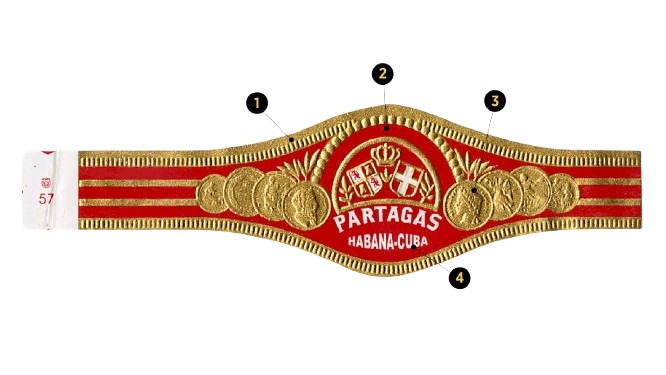
1) High-quality Gilding
When you hold the gold border up to the light, it should have a noticeable shine. Running your fingers along this border, you ought to feel distinct raised notches.
2) Removal Of “Cifuentes y Cia”
Prior to approximately 2007, the words “Cifuentes y Cia” were printed above the central symbol. However, on newer bands, this text has been removed. (Keep in mind that on the Partagás Culebras band, the word “Culebras” appears in this specific location.)
3) Raised and Detailed Coins
The gold coins that flank the center symbol on both sides are not only finely detailed, but embossed, too.
4) Well-printed Text:
The bright white text of the lettering should not bleed into the surrounding red at all. Also, note the serif style font of each letter.
How To Spot A Fake Hoyo De Monterrey
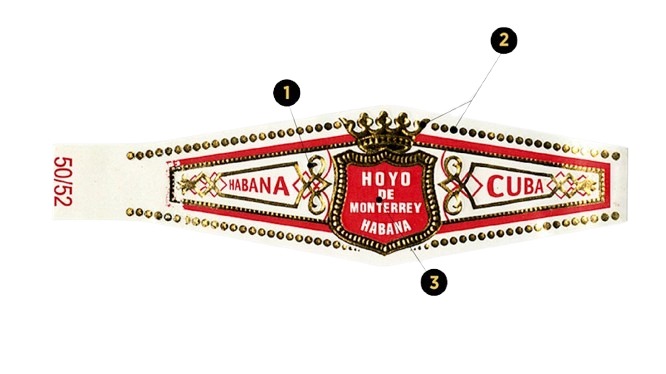
1) Embossed Scrolling
Distinctive gold scroll designs decorate both sides of the central logo. When you run your fingers over the gold, you should feel a raised texture.
2) Embossed Gold
The gold, dotted borders running along the top and bottom edges of the band have a raised texture. Similarly, the elaborate crown featured in the center logo is also embossed.
3) Embossed Lettering
The words “Hoyo de Monterrey” within the central logo are not just printed but have a raised surface that you can feel.
If you come across any counterfeit Cuban cigars in Pakistan, please let SS Alliance know by emailing info@ssalliance.com.pk or sending a message to our Facebook Page
- Published in Fake Cigar Awareness
Curbing the Influx of Fake Cuban Cigars in Pakistan

Cuban Cigar is a term that stirs the imagination of connoisseurs around the world. Smoking one is a sought-after pleasure that everyone around the world acclaims. Unfortunately, this hype around the product invites criminal elements to rip off unsuspecting customers by selling them counterfeit or fake “Cuban” cigars. Many institutions, trade unions, and governmental organizations around the world have devised ways to stop the import and/or production of counterfeit “Cuban” cigars. We at SS Alliance have managed to stop Counterfeit Cigars in the past; however, recently there has been a huge influx of Fake Cubans. Counterfeit Cigars don’t only ruin your pleasure, they are extremely hazardous for your health. They are primarily made of waste Tobacco on the factory floor including rat droppings, human hair, dust, etc. This isn’t just extremely unpleasant but is a serious health hazard too. These foreign elements could cause serious health issues and can even be poisonous!
It does not always take an expert to spot a fake Cuban cigar. With practice and a keen eye, you can spot one too. At SS Alliance we not only believe in using our channels and clout to block the import and distribution of fake cigars but we also want to spread this awareness in the Pakistani cigar market to make sure no one gets health problems or is ripped off of their precious money.
Here, we are presenting you with a few tips to spot a fake Cuban cigar:
1. Buy From SSAlliance authorized retailers and spot SS seal:
Every original box of cuban cigars can only come through its exclusive distributor in the region. Therefore, only buy from SS Alliance’s official retailers. SS Alliance applies 2 stickers on every box that is being distributed in Pakistan. Look for the ‘Guarantee of Quality’ Seal and the white ‘Smoke Authentic’ sticker at the bottom.
2. There are no cheap Cohiba, Montecristo and Limited edition cigars:
Yes, you can get sales and bargains around the world, but there are no cheap Premium Cuban cigars. The prices are usually regulated and costs-of-sales too high to ever present a ridiculously low price. So if you come across a really cheap “Cuban”, it is probably fake!
3. Labels go on the box:
Learn about the three main labels on a Cuban cigar box: a Habnos label, a stamp at the bottom of the box and a seal with a barcode.
Usually counterfeit products have these labels “inside” the box. A genuine product will always have these three “on” the box! Below is the picture of the labels as a reference:
4. Use the code:
You can never be too sure; just use the barcode on the seal of the box, run it on Habanos.com and verify in seconds if you have an original product!
5. There are no glass/ plexiglass boxes:
Cuban cigars rarely come in anything other than a wooden box. Many counterfeit Cuban cigars come in wooden boxes with glass/ plexiglass tops or simply glass/ plexiglass boxes. Beware of them. See point 9 too!
6. Missing cigar documentation:
Documentation must be present in the boxes. This documentation varies from box to box, depending on whether the box belongs to the normal production or to limited editions, regional editions or other non-ordinary series. If that paper with a transparent-tissue feel is missing; the box is probably of fake “Cubans”.
7. Touch:
Touching the cigar gently, you can notice that it has good construction. In counterfeit cigars, the filling is usually very low. This makes the cigars feel very soft to the touch!
8. Bottom stamps:
From the year 2000, the bottom of the box of a Habonos cigar has two codes in blue or black. One code is a unique three-letter indicator of the factory of origin. The other is a combination of the first three letters of the Spanish month and the last two digits of the year of production.
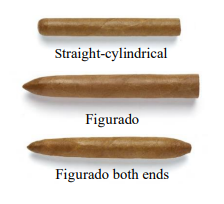
9. Shapes:
A habanos cigar may have three shapes; cylindrical, figurado from one end or figurado from both ends. Unless it is a special cigar, a Cuban cigar is very unlikely to have any other shape.
10. Unique containers:
Some special edition bundles are stored in collectible cabinets ceramic jars or leather cases etc. These are collectible items meant to improve the preservation of these cigars and are produced in very limited numbers. Be mindful while buying such unique containers and always check the documentation.
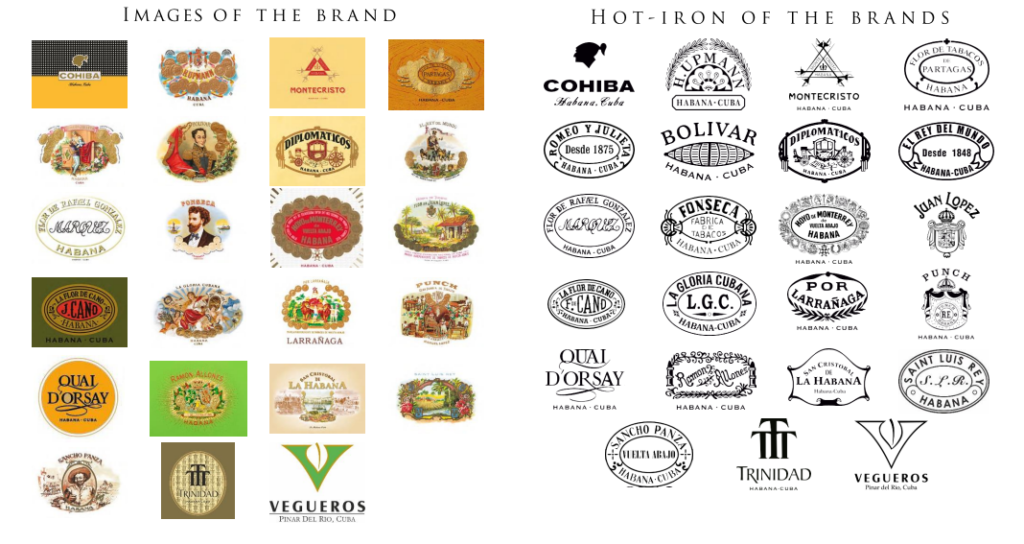
11. Brand insignia and logos:
Get familiar with the unique brand elements of each Habanos brand. There are two main types; an insignia and a hot-iron of the brand. Use the picture below as a reference for your next cigar purchase.
In conclusion, fake cigars aren’t just bad for your pocket; they are extremely dangerous for your health too. Cheap and counterfeit cigars won’t shy away from using poisonous or seriously injuring ingredients that could cause you acute gut issues, can be poisonous or even fatal at times. Your safest bet is to buy from a cigar dealership that you trust. SS Alliance owns the exclusive distributor license of Habanos SA (all Cuban Cigar brands) in Pakistan. Always buy 100% authentic and genuine cigars from our authorized retailers only!
Let’s say “no” to counterfeits.
- Published in Fake Cigar Awareness